)
)
)
Sarah Ghosh: On the quantum 'game-changer' for financial services
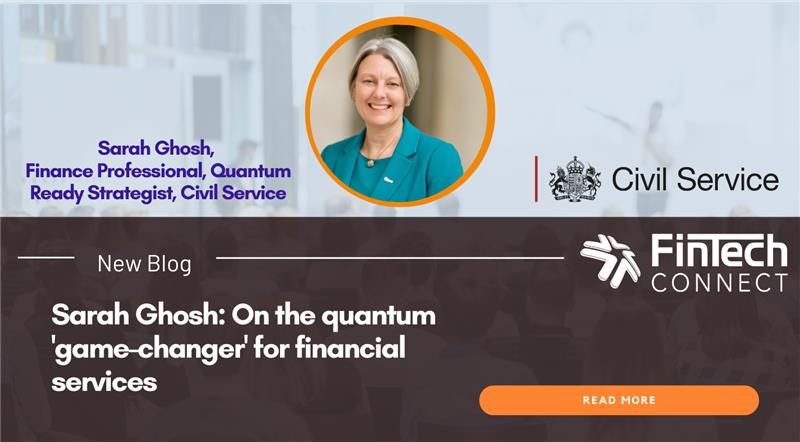
There may be plenty which remains uncertain in quantum computing. Yet the most forward-thinking financial services organisations are moving quickly – and the UK has a ‘really important role to play’ in this sector, according to Sarah Ghosh, finance professional at the UK Civil Service and quantum-ready strategist.
Quantum computing, in which qubits, the quantum states of individual particles, are harnessed to perform calculations far beyond that of any classical computer, is just one application of quantum technology, alongside quantum networks, security, and sensing. The potential is such, Ghosh notes, that it will ‘enable us to answer questions we don’t even know we need to ask yet’.
“It’s the same kind of journey we’re on with artificial intelligence and agentic AI,” says Ghosh. “It’s the same principles of what we need to be preparing for around people skills, technology stack and security. We just need to be aware of what’s coming so we can at least start to understand the impact on business models.”
The UK’s National Quantum Strategy, published in 2023, set out a 10-year commitment to the wider technology, and outlined a £2.5 billion investment during the coming decade alongside aiming to attract ‘significant’ additional private investment on top of that. Among the UK’s current initiatives are the National Quantum Computing Centre, as well as a specialised Quantum Software Lab at the University of Edinburgh, aimed at ‘transforming existing computational challenges into research problems that can be tackled using quantum technology’.
For Ghosh, part of her role is that of matchmaker. “We’re looking at supporting the UK Quantum Strategy, sharing best practice internally and externally, building an ecosystem, and connecting across academia, startups, and other enterprises in the quantum space,” she says.
Ghosh attends various events – the UK National Quantum Technologies Showcase earlier this month for example – and says that financial services is a ‘really interesting opportunity.’ “It’s about understanding how we can take that forward and put together really valuable use cases that will hit some of the key areas of concern,” says Ghosh.
So how is quantum computing going to impact financial services? A note from the Financial Conduct Authority (FCA), on quantum applications in financial services in October, outlines three problems which can be solved; portfolio optimisation, pricing models, and fraud detection.
It is the latter, and compliance more widely, which Ghosh particularly highlights. With classical approaches to fraud detection typically using ML models, as the FCA notes, marginal improvements led by quantum approaches could unlock ‘significant financial value.’
“I think in the world of regulation it will be a real game-changer, because it will enable us to link, a very complex regulatory environment globally, together, and identify those areas where there’s potential fraud,” says Ghosh.
Ghosh cites HSBC as an example of a leading provider in this regard ‘looking at fraud detection, the use of natural language processing to understand the complex regulatory environment’. But that is not all. The bank announced in September, on the portfolio optimisation piece, that it had demonstrated the world’s first known quantum-enabled algorithmic trading. The trial, with IBM, delivered up to 34% improvement in predicting the probability of winning customer inquiries in the European corporate bond market.
“One of the challenges we’ve got is... the infrastructure to be able to then build on what we’re already seeing around these use cases,” notes Ghosh. “How do you prepare? What do you invest in as a quantum technology stack?”
The good news, for organisations already committed to AI, is that quantum and AI go well together. McKinsey calls it a ‘potentially symbiotic’ relationship, advancing each other’s capabilities. “It won’t replace AI,” says Ghosh. “It’s really about supercharging and reshaping it.
“When you talk about quantum machine learning, it combines the processing power of quantum with the classical machine learning frameworks and algorithms. So, it’s considering if we are getting to the boundaries of what high performing computers can achieve, the next step is linking that into the quantum capability.’”
Ghosh is speaking at Fintech Connect in London on December 2-3, and her advice to financial services organisations is to be ‘curious’. The 10-year vision outlined by the government, she argues, is getting nearer, with some companies looking within a three-to-five-year period with some ‘really useful commercial offerings.’ “I think it’s important to be curious about it. Start to look at how it might impact your business model,” she says.
Her session will cover how quantum innovation will redefine regulatory operations. “The areas of monitoring surveillance, regulatory change, and regulatory reporting offer lots of opportunity to apply quantum, extending existing AI solutions, already in financial services,” says Ghosh. “The next step will enable us to do some of this quicker, and at a lower cost, and give more assurance across the whole financial services sector in the regulatory space.”